

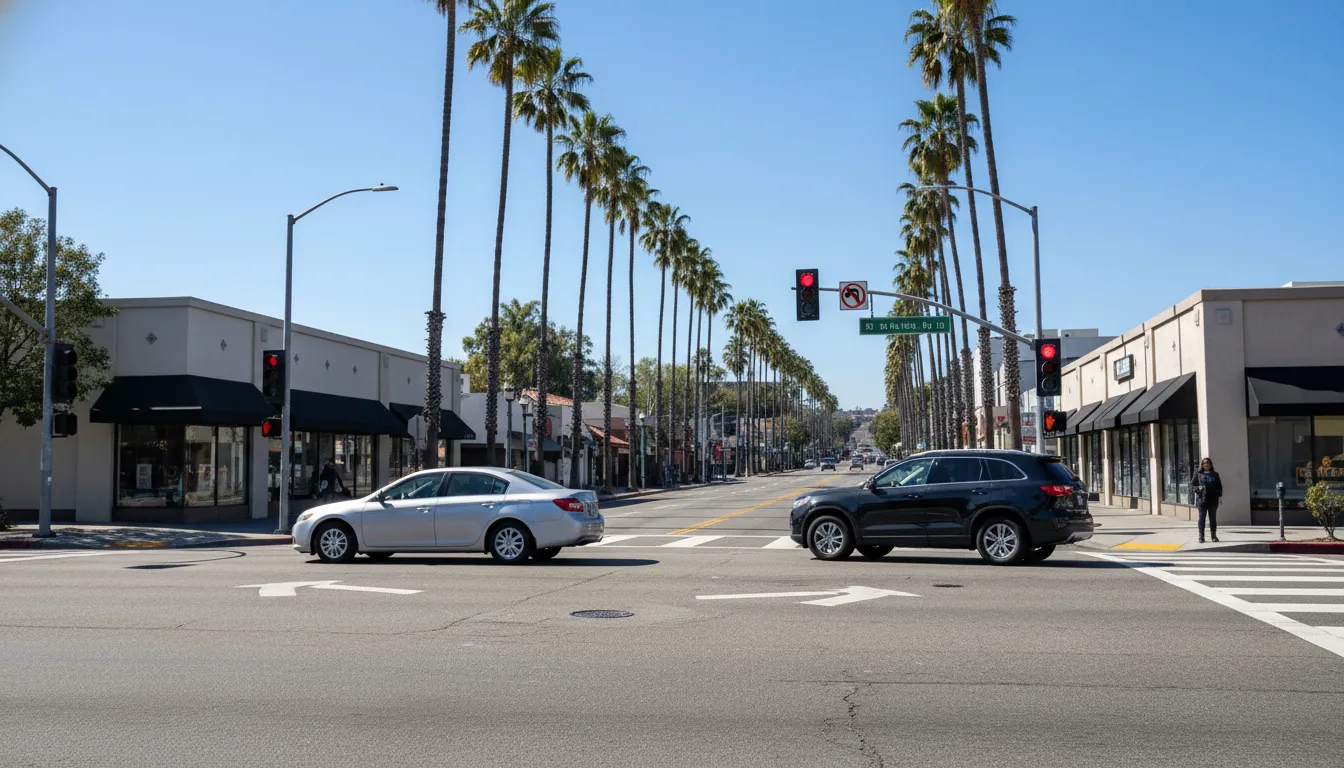
A sudden left turn can put a driver, rider, or pedestrian in an ambulance. Fault often starts with who entered the path of danger, but it does not always end there.
Request a free consultation with DC Law Group if you were injured in a disputed California left-turn collision.
Quick answer: A left turn accident lawyer California victims consult will examine whether the turning driver yielded before crossing an oncoming lane or a crosswalk. California Vehicle Code section 21801 requires a left-turning driver to yield when an approaching vehicle is close enough to create a hazard during the turn. That rule often places fault on a driver making an unprotected turn into a car or motorcycle, or turning through a pedestrian’s path. Yet a yellow light does not decide the case alone: speeding, running a signal, visibility, impact location, and witness or camera evidence may shift fault. Because California applies comparative fault, an injured person may still recover compensation even when insurers claim that person shared responsibility.
The central question is not simply whether a left turn occurred, but whether each road user obeyed the signal and acted safely. Next, we answer “Left turn accident lawyer California: who usually has fault?” with the rules that guide disputed turns. Here’s how:
Left turn accident lawyer California: who usually has fault?
The direct answer
Short answer: No. A left-turning driver is often examined first because that driver must yield to hazardous oncoming traffic. Still, a left turn alone does not settle fault. The signal, vehicle speeds, visibility, and each driver’s actions may change the result.
For someone seeking a left turn accident lawyer in California, the key issue is not which vehicle turned. The key issue is whether either driver failed to act safely before the crash. A review of California car accident claims can help explain how liability evidence fits into an injury case.
California Vehicle Code 21801
California’s starting rule is clear. California Vehicle Code section 21801 requires a left-turning driver to yield to opposing vehicles close enough to create a hazard. In plain terms, a driver cannot begin a left turn across traffic unless the gap is safe.
This rule explains why an insurer may focus first on the turning driver. The driver chose to cross an oncoming lane and had a duty to check for danger. Evidence may include traffic light timing, dashcam footage, witness statements, vehicle damage, and the point of impact.
Why fault is not automatic
A collision during a left turn does not prove that the turning driver caused every part of the crash. An oncoming driver may have entered against a red light, traveled too fast for safety, or made another unsafe move. Road design or a blocked view may also matter when investigators reconstruct what occurred.
California also allows fault to be divided when more than one person contributed to an injury. Under the state’s comparative fault instruction, a person’s recovery is reduced by that person’s share of responsibility. This means evidence matters even if a left turn is involved.
Useful records should be gathered as soon as possible. Photos of lane markings and signals can show how the intersection worked at the time. A police citation can be relevant, but it is not the only proof used when fault is disputed. Video, witness contact information, medical records, and the police report may help connect the crash to the injuries claimed.
What evidence can change liability after a left-turn crash?
Liability can turn on more than the point of impact. California law says a left-turning driver must yield to oncoming vehicles close enough to create a hazard during the turn. Evidence may show whether the light, traffic, or another driver’s speed changed that picture.
Proof to preserve at the scene
Start collecting proof as soon as it is safe. This record gives a California car accident lawyer concrete details to compare with each driver’s account. It can also preserve facts that disappear when vehicles move or cameras overwrite footage.
-
Photograph the scene. Capture vehicle positions, damage, skid marks, debris, lane arrows, signals, and sight obstructions. Take wide views and close views.
-
Get witness information. Ask for names and contact details from people who saw the light or the turn. Record brief statements only with consent.
-
Look for video. Note nearby businesses, homes, traffic cameras, and dashboard cameras. Ask quickly that available footage be saved.
-
Preserve speed evidence. Save dashcam files and phone photographs before devices are repaired or replaced. Counsel may later seek vehicle data or other speed records.
-
Request police documentation. Obtain the report number and agency details. The report may record statements, diagrams, citations, and observed damage.
-
Document medical care. Get needed treatment and report symptoms clearly. Keep discharge papers, visit records, bills, and work restrictions together.
Records that test each account
Traffic signal phase matters when one driver says there was a protected arrow and the other says there was not. Video and witness accounts can help test those versions. Vehicle damage and scene photographs may also help show angles, lane position, and movement at impact.
Police documentation collects early observations, but other proof may add context or challenge a statement. Medical records serve a different role: they document the injury report and the timing of care. They do not, by themselves, show which driver caused the collision.
Why the complete record matters
Fault is not always limited to one person. California’s civil jury instruction says damages are reduced by a plaintiff’s share of responsibility. The state’s comparative fault instruction explains that rule. Signal proof, speed evidence, and clear scene records can therefore affect how responsibility is assessed.
Keep originals in one secure folder, with dates and source names. Do not edit images or post collision details online. An organized file makes it easier to review what happened while memories are fresh and evidence remains available.
Can a yellow light or speeding driver shift fault?
A yellow light is not an automatic answer
A yellow light often creates a sharp dispute after a left-turn crash. One driver may say the turn started before the light changed. The other may say there was no safe gap. Under California Vehicle Code section 21801, a left-turning driver must yield to oncoming vehicles close enough to pose a hazard during the turn.
That rule does not end every case against the turning driver. An approaching driver may reduce the time to judge a safe opening by speeding. A driver who runs a red light or leaves a marked lane may also bear fault. The issue is what each driver did just before impact.
Facts that can change the fault analysis
In a yellow-light dispute, the traffic signal is one part of the record. Vehicle damage, crash position, video, witnesses, and event data may help show speed and direction. They may show whether an oncoming driver stayed straight, changed lanes, or sped up near the intersection.
A turn signal may matter as well. It can warn traffic, cyclists, and pedestrians that a driver plans to cross their path. California law requires a motorist to signal during the last 100 feet before turning. The rule appears in Vehicle Code section 22108. A missed signal may help show why a turn was not safe.
- Camera footage may show the light color as each vehicle entered.
- Skid marks and vehicle data may help assess speed or braking.
- Witness accounts may describe lane changes, turn signals, or a late entry.
Shared fault under California law
More than one act can cause the same collision. A turning driver may have chosen a poor gap, while an oncoming driver may have been speeding. California uses comparative fault. Damages may be reduced by a person’s share of blame, rather than denied because that person shares fault.
For that reason, a citation or first police view may not settle the civil claim. Evidence can support a different split of fault between drivers. DC Law Group’s guide to comparative fault in California personal injury cases explains how shared blame may affect a recovery claim.
Left turns involving motorcycles and pedestrians
Why the impact is different
A left-turn crash may put a rider directly in the turning vehicle’s path. A motorcycle offers no cabin or side panel between the rider and the impact. A person walking has even less protection. These cases often start with pain, shock, and urgent questions about who had the right of way.
For a rider, visibility can be central to the dispute. A driver may say the motorcycle was hard to see. Road photos, lighting, sight lines, and video may tell a fuller story. An injured rider can review claim issues with a Los Angeles motorcycle accident lawyer while medical care continues.
Crosswalks and turning duties
California’s left-turn rule requires a turning driver to yield to approaching vehicles that are close enough to create a hazard. This duty matters when an oncoming motorcycle reaches an intersection as a car begins turning. California Vehicle Code section 21801 asks whether the turn could be made safely.
A pedestrian may also be in the path of a left turn. Under California Vehicle Code section 21950, a driver must yield to a pedestrian in a marked crosswalk. The same rule applies in an unmarked crosswalk at an intersection. A turn signal does not remove that duty.
At dusk, after dark, or in busy lanes, a turn may become harder to judge. Drivers still need to look for people already crossing. They also must watch for motorcycles coming from the opposite direction. Useful evidence may include crosswalk markings, signal timing, street lighting, and witness accounts of the view.
Documenting injuries and the scene
Motorcycle riders and pedestrians may leave the scene by ambulance. Other injuries may become clear later. Seek medical care, follow treatment advice, and describe each symptom to the provider. Records can link the crash to diagnosed head pain, fractures, road rash, limited movement, or emotional distress.
If it is safe, preserve photos of the vehicle damage, motorcycle, clothing, helmet, crosswalk, and traffic controls. Keep medical bills, work-loss records, repair estimates, and witness names. A left turn accident lawyer in California can use those records to assess liability and claimed harm.
Common left-turn scenarios and the facts that matter
Why the setting changes the dispute
A left-turn crash can look clear at first, but the key question changes with the setting. Signal color, traffic flow, and the person struck can each shape the dispute. California law requires a turning driver to yield to oncoming vehicles close enough to be a hazard. That rule appears in California Vehicle Code section 21801.
Photos and statements should answer precise questions, not just show vehicle damage. Where was each person before impact? Which lane was open? Did a signal, blocked view, or stopped vehicle affect what the turning driver could see? These details help explain why two left-turn crashes may lead to different fault arguments.
Four common fact patterns
The same turn can create a different case file at an open intersection, a yellow signal, or a crosswalk. The comparison below focuses on the disputed fact in each pattern and the records that may preserve it.
| Scenario. | Fact at issue. | Proof to preserve. |
|---|---|---|
| Unprotected intersection turn. | Was traffic close enough to create a hazard? | Dashcam video, lane photos, rest positions, and witnesses. |
| Left turn at a yellow light. | Did the turn begin safely before the signal changed? | Video, signal sequence data, witnesses, and police diagram. |
| Left turn into a crosswalk. | Was the pedestrian already crossing? | Crosswalk photos, camera footage, and witnesses. |
| Left turn in front of a motorcycle. | Was the rider visible while approaching? | Video, skid marks, debris, and damage photos. |
A turn signal or green arrow does not remove a crosswalk issue. A driver must yield to a pedestrian crossing within a marked or unmarked crosswalk at an intersection. This duty is stated in California Vehicle Code section 21950. Video can show whether the person was already crossing when the vehicle moved.
A motorcycle crash often raises questions about line of sight, lane position, and the timing of the turn. Photos of sight obstructions and impact points can be as useful as statements. Injured riders can also review issues with a California motorcycle accident lawyer while preserving records tied to the collision.
Evidence to gather before it is lost
Start with facts that may change or disappear: vehicle positions, debris, skid marks, traffic signs, lane markings, and any nearby camera locations. Take wide photos of the intersection, then close photos of impact areas and injuries. Save the police report number and contact details for each witness.
Do not rely on a single account of the crash. A left turn accident lawyer in California may compare video, signal timing, medical records, and witness accounts against the road layout. That review can clarify which fact is contested and which proof supports it.
What should you do after a California left-turn collision?
The first hours after the crash
A left-turn crash can leave you hurt, shaken, and unsure what matters next. Start with your safety and medical needs. Then take steps that protect a clear record of what happened. These steps can help a left turn accident lawyer in California review the crash later.
If you can act safely, follow the steps below. Do not argue about fault at the scene. Under Vehicle Code section 21801, a left-turning driver must yield to oncoming vehicles close enough to be a hazard.
-
Get medical care. Call 911 when anyone may be injured or needs urgent help. Accept emergency care when needed. If an ambulance does not take you, seek prompt care for pain or other symptoms. Tell each provider where you hurt and how the crash occurred.
-
Report the collision. Ask law enforcement to respond, especially when there are injuries or disputed facts. Give a calm and accurate account. Get the report number and the officer’s agency before you leave, if possible. Write down where and when the crash occurred.
-
Preserve what you can see. Take photos of vehicle damage, traffic lights, turn lanes, skid marks, debris, and visible injuries. Photograph the wider intersection too. Save dashcam video at once. Collect witness names and contact details. Note nearby cameras without confronting owners or employees.
-
Keep documents together. Save discharge papers, bills, receipts, repair estimates, tow records, insurance messages, and work absence notes. Keep photos and videos in their original form. Start a short dated log of pain, care visits, and limits on daily tasks.
-
Handle calls with care. Report the crash to your insurer, but keep your account brief and factual. Do not guess about speed, distance, injuries, or fault. Before signing forms or giving a recorded statement, ask whether a California car accident lawyer should review the request.
A clear evidence file
Left-turn cases can depend on small scene details. Preserve what exists now, before a video is removed or a witness becomes hard to find. Create one folder for photos, reports, contact details, claim letters, and emails. Back it up where you can reach it later.
Keep copies rather than giving away your only record. Save any release, medical authorization, or written statement an adjuster sends. Keep the envelope or email with it. Avoid posting crash details or injury updates online while the claim is under review.
Careful contact and a timely review
Get advice early if an insurer seeks a statement or signature. A prompt review can show which records to save and which questions need answers. It can also help you ask for available camera footage before it is no longer kept.
If you were hurt in a left-turn collision, gather the records you have. Then request a free consultation to discuss the crash, insurer requests, and evidence that may still be available.
Frequently Asked Questions
What is the left turn law in California?
California Vehicle Code section 21801 requires a left-turning driver to yield to approaching traffic that is close enough to be hazardous during the turn. Under California law, the driver may continue after yielding, and approaching drivers must then yield once the turn is lawfully underway. This rule applies at intersections and to unprotected turns.
Is the person turning left always at fault in a California accident?
No. A left-turning driver is often responsible when that driver fails to yield, but fault depends on the full evidence. An oncoming driver may share fault for speeding, running a signal, or failing to avoid a visible hazard. Under California comparative negligence rules, an injured person’s recovery can be reduced by that person’s share of fault, according to California jury instructions.
Can a driver making a left turn be liable for hitting a pedestrian or motorcyclist?
Yes. A driver making a left turn must watch for more than oncoming cars. California law requires a driver to yield to a pedestrian in a marked or unmarked crosswalk at an intersection, as stated in Vehicle Code section 21950. A motorcyclist also may have the right-of-way as approaching traffic under section 21801.
How is fault proven in a California left turn accident involving a yellow light?
A yellow light dispute usually turns on timing and safe movement, not the color alone. Evidence may show whether the turning driver crossed into an unsafe gap, or whether the oncoming driver sped up or entered too late. Useful evidence includes traffic-camera video, dashcam footage, witness statements, vehicle damage, signal timing records, and the collision report. Each driver’s actions may affect the final fault allocation.
Ready to protect your California left-turn injury claim?
After a left-turn crash, delay can allow evidence to disappear and give insurers more room to dispute how the collision happened. Photos may be lost, nearby video may be erased, and witnesses may forget important details as more time passes. Starting now gives a legal team time to preserve available proof, assess fault questions, and explain your options before key decisions arise.
Ready to protect your California left-turn injury claim? Request a free consultation today to discuss the crash, the evidence you have, and practical next steps with DC Law Group. You can ask what information matters, what deadlines may affect your claim, and how to respond when liability is disputed.